
For years, the debate in the tech industry has been binary: Cloud vs. On-Premise. It was a battle of convenience versus control, scalability versus sovereignty. But as we approach 2026, that binary distinction is dissolving. The most successful AI architectures are no longer choosing a side; they are orchestrating a symphony between the two. The convergence of edge computing and local AI inference is not just a trend–it is a fundamental shift in how we process data.
This shift is driven by a single, undeniable reality: the cloud cannot solve every problem, and on-premise hardware cannot scale infinitely. To unlock the true potential of Artificial Intelligence, developers and architects are looking toward a hybrid future. In this post, we will explore why the most robust systems of the future will be built on the foundation of edge computing, and how local inference is becoming the critical partner to global infrastructure.
The Hidden Cost of Sending Data to the Cloud
One of the primary drivers of this convergence is economics and compliance. While the cloud offers infinite scalability, it introduces a hidden cost structure that many organizations are only now beginning to quantify. Every time data leaves a device to travel to a central server, you incur latency, bandwidth fees, and potential privacy risks.
In our previous analysis of infrastructure costs, we discussed the “Hidden Cost of Cloud Computing” The Hidden Cost of Cloud Computing: Why Your Local GPU Is the Missing Piece of the Puzzle. The core argument there remains valid and more critical today: moving massive datasets of unstructured information–such as audio, video, or sensor logs–across the public internet is inefficient.
When you run local AI inference, you process data at the source. A camera in a retail environment can analyze customer behavior locally without sending video streams to the cloud. A manufacturing plant can detect equipment failure instantly on a local server. By keeping sensitive or high-frequency data local, you eliminate the “tax” of network transfer.
This is where edge computing steps in. The edge is not just about speed; it is about data gravity. By processing data at the edge, you reduce the payload size before it ever reaches the cloud. This creates a feedback loop where the cloud handles aggregation and training, while the edge handles the heavy lifting of real-time decision-making. The result is a system that is faster, cheaper, and more secure.
The Serverless Edge: Running Code Where It Matters
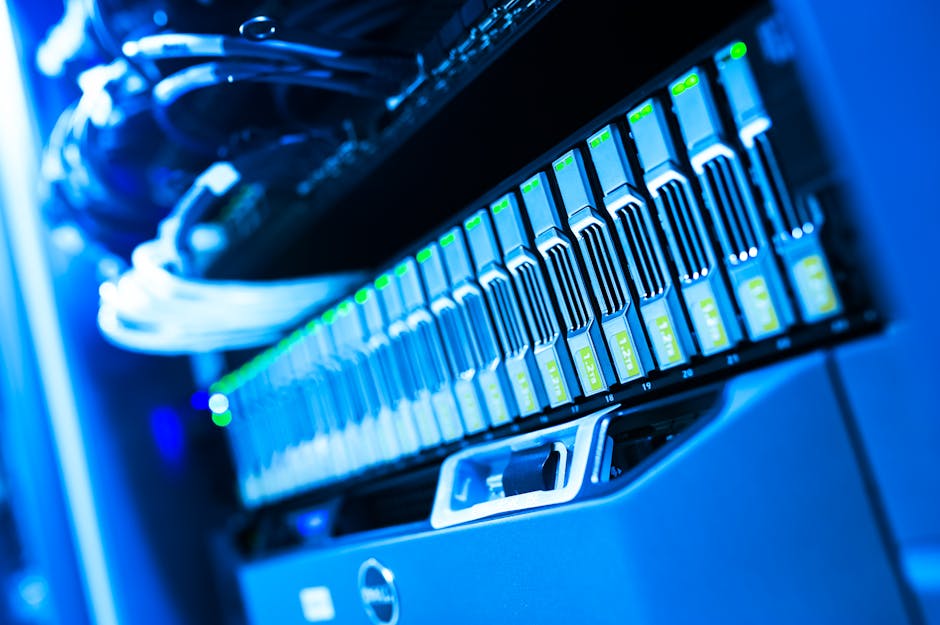 Photo by panumas nikhomkhai on Pexels
The technical mechanism enabling this convergence is the rise of serverless computing at the edge. Historically, “edge computing” implied managing physical hardware in remote locations–a nightmare of maintenance, updates, and power management. Today, serverless edge architectures are changing the game.
Services like Cloudflare Workers Cloudflare Workers Documentation allow developers to deploy JavaScript or Rust code to thousands of locations worldwide. Similarly, AWS Lambda@Edge AWS Lambda@Edge allows you to run code at the edge of the AWS network.
These tools bridge the gap between the local world and the cloud. They allow you to run lightweight inference models (like small language models or computer vision classifiers) directly on the CDN nodes that are geographically closest to the user.
Consider a user interacting with a generative AI chatbot. In a traditional setup, the request travels to a central data center, processes, and returns. In a converged edge-local setup, the request hits a Cloudflare Worker. The worker decides if the request is simple (e.g., “What is the weather?”) and handles it instantly. If the request requires complex reasoning, the worker offloads the task to a local GPU server or a larger cloud instance, but only when necessary.
This architecture requires zero server management. You don’t need to patch a server in a remote office; you just update your code. This is the essence of the edge-local convergence: the intelligence is distributed, but the management is centralized.
From Struggling With Cloud Costs to Mastering Local Hardware
For decades, the barrier to entry for high-performance AI was the cost of GPUs. Buying a high-end NVIDIA A100 or H100 card costs tens of thousands of dollars. Cloud providers charge exorbitant hourly rates for access to these units. This created a dichotomy where startups could afford cloud compute but not hardware, and enterprises could afford hardware but feared the operational overhead.
However, the economics are shifting. As local AI inference technology matures, the “break-even point” is becoming increasingly favorable for local deployment. We detailed the financial implications of this shift in our “Break-Even Guide” Cloud vs. Local: The Ultimate Break-Even Guide for AI Inference.
In 2026, the convergence model looks like this: You invest in a single, robust local server (or a cluster of consumer-grade GPUs). This server acts as your private inference engine. For predictable workloads–such as processing internal documents, generating code for developers, or analyzing customer support tickets–you use the local server. It amortizes its cost over thousands of requests with near-zero marginal cost.
The cloud is no longer used for the heavy lifting of inference, but for the heavy lifting of training and fine-tuning. You train your model in the cloud, push the weights to your local edge servers, and let them run inference. This is the “Railway Advantage” we discussed earlier Turning Local Dreams into Global AI Services: The Railway Advantage. It turns a static asset (hardware) into a dynamic service.
This approach eliminates the “surprise” bills that come with cloud compute. You know exactly what your hardware costs are, and you know exactly what your inference costs are. This predictability is crucial for businesses scaling AI operations.
The Invisible Backbone: Turning Edge Concepts into Reality
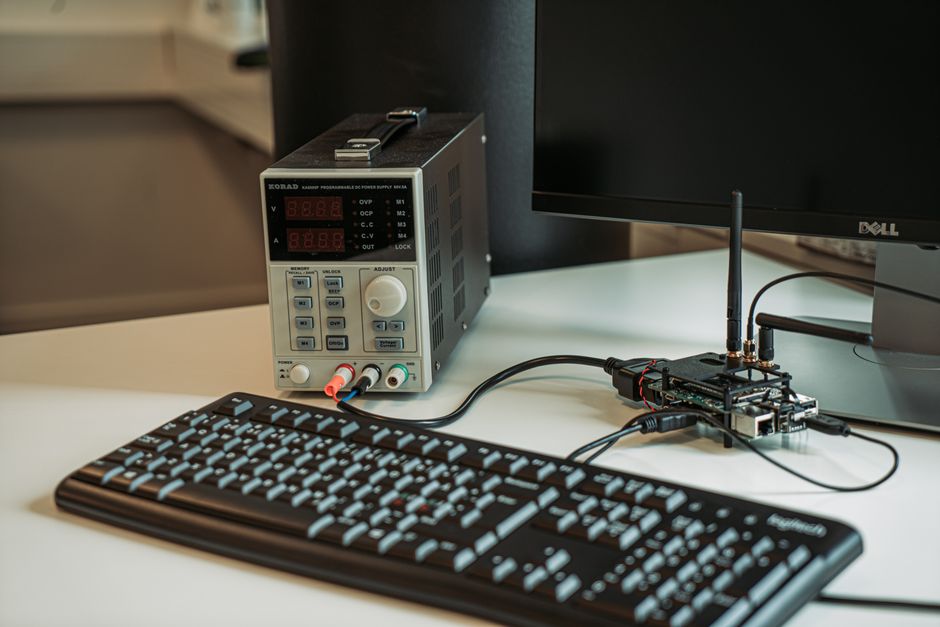 Photo by Michal Hajtas on Pexels
Implementing this hybrid architecture is one thing; understanding the infrastructure that makes it possible is another. The “Invisible Backbone” The Invisible Backbone: Turning Edge Computing Concepts into Reality is the complex network of protocols, containerization, and orchestration that ties these disparate systems together.
To achieve true convergence, you need a way to manage local resources as if they were cloud resources. This is where containerization (Docker) and orchestration (Kubernetes) come into play. You deploy your AI models as containers to your local server. These containers are then managed by an orchestration layer that communicates with your edge functions.
This layer handles the routing logic: “If the user is in London, route the request to the London edge node; if the request requires model version 2, route it to the local server.” The complexity is hidden from the end-user, but the architecture is robust.
This requires a mindset shift. Developers must stop thinking about “where” the code runs and start thinking about “when” and “why” it runs. The infrastructure is no longer a static network; it is a fluid, intelligent mesh. By mastering this mesh, organizations can create applications that are responsive, intelligent, and resilient.
Your Next Step: Designing for the Hybrid Future
The migration to a hybrid edge-local architecture is no longer optional. The limitations of pure cloud computing–latency, cost, and privacy–combined with the limitations of pure local computing–scalability and maintenance–are making the hybrid approach the only viable path forward for serious AI workloads.
As we look toward 2026, the successful organizations will be those that have integrated their local inference engines with global edge networks. They will be the ones who have stopped asking “Cloud or Local?” and started asking “How can we use both?”
The transition requires planning. It requires investment in robust local hardware and expertise in edge computing protocols. But the payoff is immense: a system that is faster, cheaper, and more private.
Your Action Plan: 1. Audit Your Data: Identify which data is sensitive and which is high-frequency. Keep the former local; send the latter to the edge. 2. Explore Serverless Edge: Experiment with tools like Cloudflare Workers to see how you can offload simple logic to the edge. 3. Evaluate Hardware ROI: Calculate the break-even point for your specific inference workloads using our guide Cloud vs. Local: The Ultimate Break-Even Guide for AI Inference. 4. Adopt Containerization: Standardize your models using Docker so they can run anywhere–on your local server, in the cloud, or at the edge.
The future of AI is not in the ether; it is right here, at the edge, and on your desk. Don’t get left behind in the cloud. Embrace the convergence.
Suggested External Resources: * Cloudflare Workers Documentation * AWS Lambda@Edge Documentation * Kubernetes Documentation * NVIDIA AI Enterprise
