
The cursor blinks on the screen, not just as a cursor, but as a pause in the conversation. For decades, software development was a solitary act of typing, a rhythmic dance between the developer’s mind and the keyboard. Today, that rhythm has changed. We are entering an era where the “developer” is no longer just the writer of code, but the conductor of an orchestra of intelligent agents. Artificial Intelligence, capable of generating entire functions, refactoring legacy systems, and suggesting complex algorithms in seconds, is fundamentally altering how we build software. But here is the catch: Git, the version control system that has held our codebases together for nearly two decades, was built for humans typing. It was not architected for AI agents.
As we integrate Large Language Models (LLMs) and AI copilots into our daily workflows, the traditional Git workflow is beginning to show its age. The noise generated by AI suggestions, the difficulty of reviewing machine-generated code, and the potential for “hallucinated” logic require a new approach. We are no longer just committing changes; we are committing trust. To survive and thrive in this new landscape, developers must evolve their Git strategies, treating version control not just as a history log, but as the primary safety net for AI-assisted development.
Why Your Old Git Strategy is Breaking Under AI Pressure
If you are still using the same Git workflow you used five years ago, you are likely facing a new set of challenges that manual typing never produced. The most significant issue is the “noise-to-signal” ratio in your commit history. When a human writes code, they usually do so in a linear, logical fashion. They write a function, they test it, they commit. When an AI writes code, especially when prompted to “fix this bug” or “implement this feature,” it often generates multiple files, refactors existing ones, and creates temporary scaffolding all at once.
This creates a messy commit graph. A single AI session can result in dozens of commits that are logically related but technically scattered across your branch. Trying to review these commits one by one is akin to trying to read a book where the chapters are out of order. To combat this, many forward-thinking organizations are pivoting away from the strict “one feature, one commit” rule that worked for human developers. Instead, they are embracing a “feature branch” philosophy where the AI does the heavy lifting of exploration, and the human consolidates the result.
The “Experiment Branch” model has emerged as a powerful solution. When an AI suggests a significant architectural change, developers are creating dedicated branches for experimentation. These branches are isolated from the main codebase. Here, the AI can generate code, run tests, and refactor without the fear of breaking production. If the experiment fails, the branch is simply deleted. If it succeeds, the consolidated changes are merged into the main workflow. This approach separates the exploration phase, where AI excels, from the integration phase, where Git thrives.
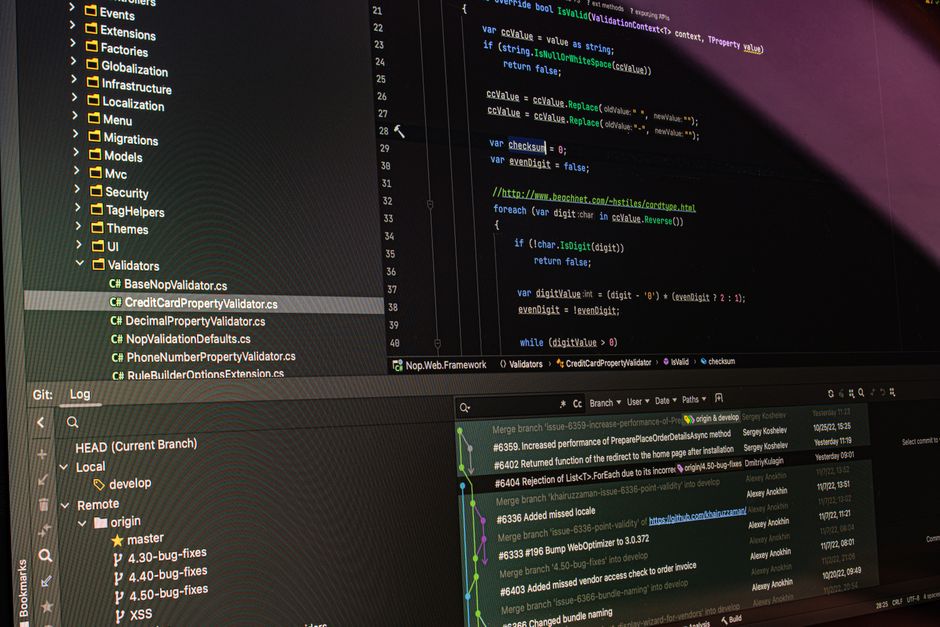
- Photo by Daniil Komov on Pexels
-
A visual representation of a Git graph showing a clean “main” branch and a chaotic “experiment” branch. On the experiment branch, there are multiple, dense commits representing AI generation. A line connects this to the main branch, symbolizing the controlled merge.
The “Hallucination” Risk and the Need for Isolation
One of the most critical aspects of modern Git workflows is handling the “hallucination” risk inherent in AI. LLMs are probabilistic engines; they are designed to predict the next token, not to retrieve facts. They can confidently invent APIs that don’t exist or logic that looks syntactically correct but fails at runtime. In a monolithic workflow, a hallucinated line of code can break your build pipeline or, worse, introduce a subtle bug that is difficult to trace back to its source.
By isolating AI experiments in separate branches, developers create a natural containment zone. If the AI generates a dependency that doesn’t exist, or a syntax error, it only affects that isolated branch. The CI/CD pipeline can be configured to run tests specifically on these experimental branches. If the tests fail, the merge is blocked automatically. This creates a “fail-safe” mechanism that is essential when working with non-deterministic AI tools. It transforms Git from a simple version control tool into a robust gatekeeper for AI-generated content.
The New PR: Where AI Writes, Humans Verify
The Pull Request (PR) has always been the heartbeat of collaborative software development. It is the ritual of peer review, the moment where knowledge is shared, and code quality is enforced. However, the introduction of AI has fundamentally altered the dynamics of the PR. The burden of the reviewer has shifted. In the past, a reviewer might spend 30 minutes reading a complex algorithm to understand its logic. Today, with AI capable of writing that algorithm in milliseconds, the reviewer must spend that time verifying the logic.
We are seeing the rise of the “Human-in-the-Loop” review process. The PR is no longer just about style and syntax; it is about architectural intent and logical correctness. The reviewer acts as a detective, looking for the seams where the AI made a mistake. This requires a different mindset. A reviewer cannot simply accept a PR that looks “good enough.” They must interrogate the changes. Did the AI introduce a security vulnerability? Is the AI using a deprecated library? Does the code handle edge cases that the AI likely ignored?
Furthermore, the PR comment thread is becoming a dialogue between the human and the AI. Developers are now using AI tools to explain specific parts of the diff, to generate test cases for the proposed changes, or to translate technical jargon into business requirements. The PR is evolving from a static document into a dynamic conversation. This changes the definition of “ownership.” The developer who merged the code might not be the one who wrote every line of it, but they are responsible for the integrity of the whole.
- Photo by Markus Spiske on Pexels
-
A split-screen view of a Pull Request. On the left, the AI-generated code diff is highlighted in green. On the right, the reviewer has added comments like “Verify this logic for null inputs” and “Consider using the new API here.”
Automated Tests as the Gatekeeper
To manage this new level of review, automation becomes non-negotiable. The most effective Git workflows for AI-assisted development are those that treat automated testing as the first line of defense. Before a human ever lays eyes on a PR, the AI should have been prompted to write unit tests for the code it generated. Git hooks, specifically pre-commit hooks, are playing a massive role here. When a developer saves a file, a Git hook can trigger an AI assistant to analyze the changes, write tests, and run the test suite.
If the tests pass, the commit is allowed. If they fail, the commit is blocked. This creates a “trust but verify” system. The AI writes the code, the AI writes the tests, and the Git workflow enforces that both must be green before the code reaches the main branch. This reduces the cognitive load on human reviewers. They know that the basic functionality has been tested and the syntax is valid. Their review can then focus on higher-level issues: performance, security, and architectural fit.
How to Automate the Boring Stuff (Without Losing Control)
One of the greatest promises of AI in software development is the automation of repetitive tasks. Git workflows are rife with these tasks: writing commit messages, formatting code, updating documentation, and running linting tools. Historically, developers have spent a significant portion of their time on these administrative duties, often doing them poorly due to fatigue or oversight. AI offers a solution, but it requires a careful implementation strategy to avoid “automation creep.”
The key is to automate the process, not the decision. For example, instead of letting an AI agent auto-commit changes to the main branch–which would be disastrous for version control–developers are using AI to summarize the changes. When a developer finishes a coding session, they can use an AI tool to look at the diff and generate a detailed commit message. This ensures that the commit history is clean, descriptive, and useful for future debugging, without bypassing the human’s control over when the commit happens.
Similarly, AI can be integrated into the CI/CD pipeline to handle the “boring stuff” of deployment. It can automatically update the CHANGELOG, tag the release, and notify the team. However, the final decision to merge to production should always remain a human action. The goal is to use AI to handle the execution of the workflow steps while the human retains the authority over the workflow steps. This hybrid approach leverages the speed of AI for routine tasks while preserving the discipline of Git for critical decisions.
The Art of the Squash and Merge
As AI generates more code, the volume of commits in a feature branch can become overwhelming. A common strategy to combat this is the “squash and merge.” This workflow takes all the commits generated during an AI coding session–perhaps twenty or thirty tiny commits–and condenses them into a single, clean commit. This makes the Git history linear and easy to understand, which is crucial for onboarding new developers or debugging complex issues.
However, this requires discipline. Developers must resist the urge to commit every time the AI suggests a change. Instead, they should treat the AI session as a continuous flow of work. They should instruct the AI to make changes, then immediately review, then commit only when the feature is complete. The Git workflow becomes less about “saving snapshots” and more about “building a story.” The squash and merge acts as the period at the end of that story, providing a clean, final narrative for that specific feature.

- Photo by Pixabay on Pexels
-
A diagram illustrating a Git branching strategy. It shows a “develop” branch merging into “main”. It highlights a “squash and merge” commit that combines multiple AI-generated commits into one logical change.
Ready to Begin?
The integration of AI into software development is not a passing trend; it is a fundamental shift in how we write code. Git, the bedrock of modern software engineering, is adapting to this shift. By moving from rigid, manual workflows to flexible, AI-enhanced strategies, developers can leverage the power of intelligent agents without sacrificing code quality or stability.
The future of Git is collaborative, automated, and human-centric. It is a future where the machine handles the syntax and the repetition, and the human handles the logic, the architecture, and the judgment. To get there, you must audit your current workflow. Are you using branches to isolate your AI experiments? Are your PRs serving as a rigorous filter for logic, not just style? Are you using automation to handle the administrative burden?
The technology is here. The tools are ready. The only question left is how you will choose to use them. The next time you open your terminal and the AI starts suggesting a solution, remember that you are not just typing code; you are curating a version of reality. And with the right Git workflow, you can ensure that version is one you can trust.
Suggested External Resources for Further Reading:
- Atlassian’s Guide to Git Branching - A comprehensive look at different Git strategies.
- GitHub Copilot Documentation - Official documentation on using AI assistants within the GitHub workflow.
- Pro Git Book - Workflow - The definitive guide to distributed version control workflows.


